
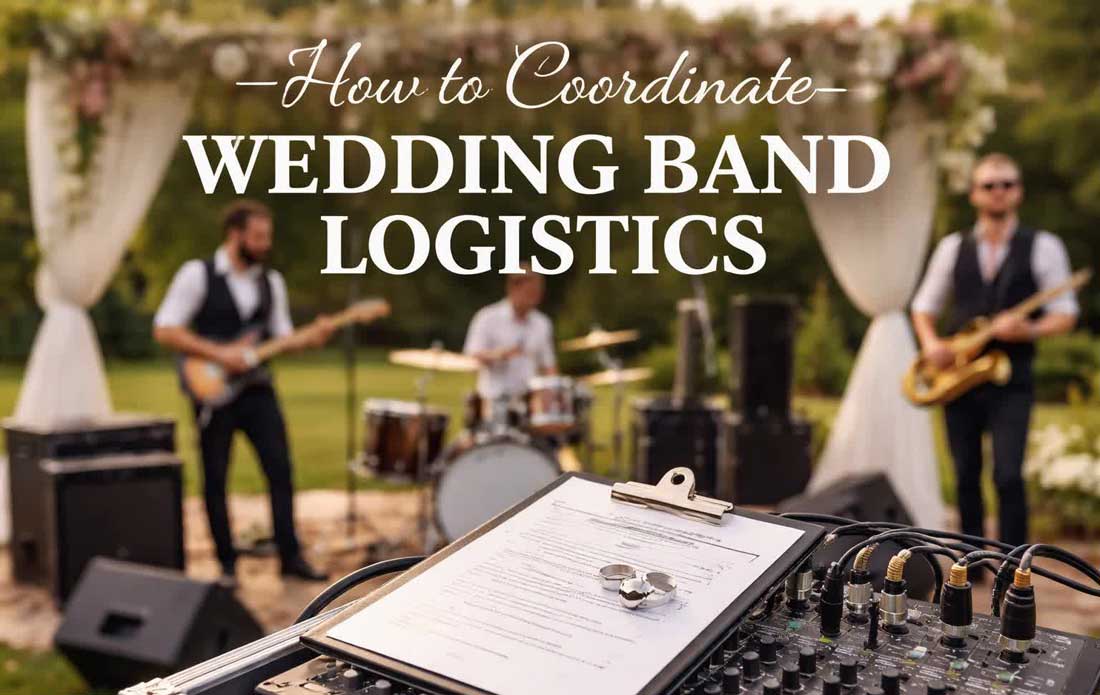
How to Coordinate Wedding Band Logistics: A 2026 Guide
Learn how to coordinate wedding band logistics step by step, from load-in to last dance. Cover rider requirements, soundcheck, and more.
Knowing how to coordinate wedding band logistics is the difference between a reception that flows effortlessly and one that stumbles through awkward silences, delayed first dances, and a band that never quite found its footing. This guide from Green Light Bands breaks down every logistical layer, from the first booking call to the final song of the night, so you can walk into your wedding day with a clear plan and zero surprises. Below, we’ll show you exactly how to build that plan, including technical templates most guides skip entirely.

Rhinestone Rodeo Country-Pop Music Wedding Band
Here’s what most planning resources get wrong: they treat the band like a vendor you book and forget. In reality, coordinating live music requires ongoing communication with your venue, event planner, and audio-visual team across multiple touchpoints. Get that coordination right, and your reception flow becomes self-sustaining. Get it wrong, and even the best musicians can’t save the evening. A couple of top bands that get everything right are the Rhinestone Rodeo Band, pumping out everyone’s favorite pop and country hits, and Party Echelon, an experienced wedding band that has more energy than the Energizer Bunny.

Party Echelon Top 40 Wedding Party Band
Why Wedding Band Logistics Make or Break Your Reception Flow
Wedding band logistics is the end-to-end coordination process that governs how a live wedding event band integrates with your venue, timeline, and vendor team to produce a seamless reception experience.
Most couples focus almost entirely on audition videos and setlists. Those matter, but they’re secondary to the operational framework underneath. A band that can’t load in on time, doesn’t know your MC cues, or runs out of power access before the first dance is a liability regardless of how talented the musicians are. The performance schedule, break management, and event flow all depend on logistics decisions made weeks before the wedding day.
The good news is that wedding band logistics follows a repeatable structure. Once you understand the key coordination points, managing them becomes straightforward. According to The Wedding Report’s industry research on live entertainment, live dance bands remain one of the highest-rated entertainment investments couples make, precisely because a well-coordinated performance creates energy that DJ sets rarely replicate. That return on investment, though, only materializes when the logistics are solid.
Takeaway
The single most important insight here is that venue coordination and band logistics must happen in parallel, not sequentially. Waiting until the venue confirms before contacting the band almost always compresses your timeline too tightly.
How to Coordinate Wedding Band Logistics: Booking Timeline and Availability
Start the booking process 12 to 18 months before your wedding date. That’s not a conservative estimate, but the realistic window for securing high-demand bands, especially for Saturday dates in peak season (May through October).
Here’s the booking sequence that works:
- Confirm your venue’s entertainment restrictions before contacting any band. Sound restrictions, load-in windows, and stage dimensions will immediately filter your options.
- Request availability and a performance sample from 3 to 5 bands simultaneously. Don’t audition sequentially; you’ll lose availability.
- Review contract terms carefully before committing. Deposit structures and overtime fees vary significantly.
- Sign and deposit as soon as possible after selecting your band. Most professional acts hold a date for a few days maximum.
- Schedule a planning call at 6 months out and again at 4 to 6 weeks before the event.

The ‘Ring’ vs. ‘Band’ Search Problem Couples Run Into
Searching “wedding band” online returns a split between jewelry results and music results, which creates a genuine research problem. Couples hunting for live music logistics advice often land on ring-buying guides, and vice versa. The fix is simple: search specifically for “wedding reception band logistics,” “live wedding band coordination,” or “wedding entertainment coordinator” to filter toward music-focused resources. When reviewing contracts, the same ambiguity appears internally. Make sure every vendor document specifies “live music band” rather than just “band” to avoid any contractual confusion.
Micro-Wedding vs. Large-Scale Reception: How Logistics Differ
Micro-weddings (typically under 50 guests) and large receptions (150 or more guests) require fundamentally different band logistics approaches.
| Factor | Micro-Wedding | Large Reception |
|---|---|---|
| Band size | 3-4 piece | 6-10 piece |
| Stage space needed | 10×10 ft minimum | 20×16 ft or larger |
| Load-in time | 1-2 hours | 3-4 hours |
| Power requirements | Single 20-amp circuit | Multiple dedicated circuits |
| Sound system | Compact PA | Full audio-visual rig |
| Coordination contacts | 1-2 vendors | 4-6 vendors |
For micro-weddings, the band often doubles as the sound system operator, which simplifies audio-visual coordination but puts more pressure on soundcheck timing. For large receptions, a dedicated lighting designer and audio engineer become essential, and vendor communication requires a formal contact sheet shared across all parties.
Wedding Band Rider Requirements: What Venues and Couples Must Provide
A hospitality rider is the band’s formal list of technical and personal requirements that must be met before and during the performance. Ignoring rider requirements is the most common logistical mistake couples make, and it surfaces at the worst possible moment: during setup, an hour before guests arrive.
Standard wedding band rider requirements typically include stage dimensions, power access specifications, parking for equipment vehicles, a dedicated setup area, and hospitality provisions. Review the rider as soon as you receive it and share it immediately with your venue coordinator. Don’t wait for your planning meeting.
Hospitality Rider Essentials: Vendor Meals and Green Room Access
Vendor meals are a contractual obligation in most professional band agreements, not an optional courtesy. A standard band of six to eight musicians performing a four-hour reception requires meals for each member, typically served during the cocktail hour or before the reception begins. Confirm with your caterer that vendor meals are included in the catering count and that a dedicated time slot exists for the band to eat.
Green room access, meaning a private space for the band to store equipment cases, change, and take breaks, is equally important. Many venues have a designated hospitality room; if yours doesn’t, work with your event planner to identify an alternative. A band without a green room will use whatever space is available, which can disrupt reception flow and create awkward guest interactions.
Warning
Never assume vendor meals and green room access are automatically included in your venue package. Confirm both in writing with the venue coordinator at least 30 days before the event. Missing either can trigger overtime fees or breach the band’s contractual obligations.
Wedding Band Load-In Instructions: Stage Setup and Venue Requirements
Load-in is the structured process by which the band arrives, unloads equipment, and sets up before the event begins. A well-executed load-in is invisible to guests. A poorly managed one creates setup chaos that bleeds into cocktail hour.
Provide the band with written load-in instructions at least two weeks before the wedding. These should include the venue address, specific entrance for vendor access (often different from the guest entrance), parking location for equipment vehicles, elevator access if the reception is on an upper floor, and the name and cell number of the on-site venue contact.
Stage Dimensions, Risers, and Load-In/Load-Out Access
Stage dimensions are non-negotiable. A four-piece band needs a minimum of 16 feet wide by 12 feet deep. A seven-piece band requires at least 20 feet wide by 16 feet deep. Risers add height visibility but require additional floor space and load-bearing confirmation from the venue.
Confirm these specifics with the venue in writing:
- Floor surface: Is the stage area hardwood, carpet, or a portable stage platform? This affects riser stability.
- Ceiling height: Minimum 10 feet for most standard setups; horn sections and full drum kits may require more.
- Load-in window: When can the band access the space? Most professional acts need 2 to 4 hours minimum.
- Load-out deadline: Does the venue impose a hard end time for equipment removal? Overtime fees often apply after midnight.
- Elevator dimensions: If equipment must travel by elevator, confirm the interior dimensions accommodate speaker cabinets and road cases.
According to National Association of Music Merchants guidance on live event setup standards, inadequate stage preparation is among the top causes of sound quality issues at live events, which directly supports the case for confirming these details early.
Wedding Band Power Requirements and Audio-Visual Coordination
Wedding band power requirements are the electrical specifications a band needs to operate safely and at full capacity. Most professional bands require dedicated 20-amp circuits, separate from lighting and catering equipment, to prevent breaker trips during the reception.
A standard six-piece band with a full PA system typically draws between 30 and 50 amps of power. Larger bands with horn sections, additional monitors, and full lighting rigs can draw significantly more. Share the band’s technical rider with your venue’s facilities manager and confirm that dedicated circuits are available and properly labeled before the event.
Audio-visual coordination goes beyond power. If your venue has a house sound system, determine early whether the band will use it or bring their own. Mixing these systems without proper coordination creates feedback, volume inconsistency, and delays during soundcheck. The cleanest approach: let the band use their own system unless the venue’s audio-visual setup is specifically designed for live music integration.
For venues with a lighting designer on staff, schedule a coordination call between the band’s production manager and the venue’s AV team at least two weeks before the event. Establish who controls stage lighting during the performance, how the lighting designer receives cues for key moments (first dance, grand entrance), and whether the band’s on-stage lighting rig is compatible with the venue’s power panel.
Tip
Ask the band’s production manager for a technical input list, also called an input spec sheet. This document lists every microphone, direct input, and monitor requirement. Share it with the venue’s audio-visual contact immediately. It prevents the most common soundcheck delays.
Wedding Band Soundcheck Timeline: What Happens Before Guests Arrive
The wedding band soundcheck timeline is the scheduled window, typically 60 to 90 minutes before doors open, sometimes sooner, during which the band tests levels, monitors, and equipment to ensure everything is performance-ready before guests arrive.
A well-run soundcheck typically follows this sequence, but can take longer than specified below:
- Drums and bass first (15 minutes): Establish the rhythm section’s monitor mix and front-of-house levels.
- Add guitars and keys (10 minutes): Balance against the rhythm section.
- Vocals (15 minutes): Check lead and backing vocal levels, monitor mixes for each singer.
- Full band run-through (20 minutes): Play two to three songs at performance volume to identify any issues.
- Adjustments and fine-tuning (10 minutes): Address feedback, monitor complaints, or level imbalances.
- Clear the stage (5 minutes): Band moves to green room; venue completes final setup.
The most common mistake is scheduling soundcheck too close to guest arrival. Build in at least a 30-minute buffer between the end of soundcheck and the first guests entering the space. That buffer absorbs inevitable delays without affecting the reception timeline.
How to Coordinate Wedding Band Logistics During the Reception
Coordinating wedding band logistics during the reception means managing real-time communication between the band’s bandleader, your event planner, and the venue coordinator to keep the performance schedule aligned with the reception timeline.
The bandleader is your primary point of contact during the event. Before the reception begins, give the bandleader a printed copy of the full reception timeline, including exact times for the grand entrance, first dance, parent dances, dinner service, cake cutting, and any special announcements. Most professional bandleaders will adapt in real time, but they need the baseline plan in writing.
MC Duties, Announcements, and Managing the Performance Schedule
Many wedding bands include MC duties as part of their service, meaning the bandleader or a designated vocalist handles formal announcements throughout the evening. Clarify this scope during the planning process, not the week before.
If the band is serving as MC, provide a written script for all announcements: the grand entrance names and pronunciation guide, the first dance introduction, the parent dance dedications, and any toasts or special moments. Verbal instructions passed through a third party during the reception create errors.
The performance schedule should be built around the reception timeline, not the other way around. A typical four-hour reception might structure the band’s set as follows: 30 minutes of cocktail-style background music during dinner, a 15-minute break, 45 minutes of dance sets, a 10-minute break, and 45-60 minutes of final dance sets through the last song. Break management is critical here because unmanaged breaks create dead air that kills event flow.
Playlist Curation, Guest Song Requests, and First Dance Coordination
Playlist curation for a wedding band is a collaborative process between the couple and the bandleader, typically finalized 4 to 6 weeks before the event. A professional band will provide a song catalog from which you select must-plays, do-not-plays, and preferred genres for each segment of the evening.
The first dance deserves special attention. Confirm the specific arrangement the band will use, whether it’s the original key, tempo, and length or a custom version. Some bands offer shortened arrangements for couples who want the emotional moment without a full three-minute song. Decide this early and rehearse the cue with the bandleader.
Guest song requests are a genuine logistical challenge. The cleanest approach: set a clear policy in advance. Either the band accepts requests at their discretion, or requests are filtered through the event planner to the bandleader. Never allow open-floor requests without a filter; it disrupts the set flow and puts the band in an uncomfortable position when they can’t accommodate a request mid-set.
Break Management and Keeping Event Flow Uninterrupted
Breaks are inevitable for a live band performing a multi-hour reception, but dead air is avoidable. Work with the band in advance to establish what happens during breaks: curated background music from a playlist, a DJ mix, or silence. Most professional bands provide a break music solution as part of their package. Confirm this in the contract.
Time breaks strategically. The best break windows are during extended dinner service, between the cake cutting and open dancing, or during a slideshow or video presentation. Avoid scheduling breaks immediately after a high-energy dance set; the crowd momentum will drop faster than you can recover it.
Contract Terms, Payment Schedules, and Post-Pandemic Clauses to Know
Wedding band contracts have evolved significantly since 2020, and couples booking today are signing documents that look materially different from pre-pandemic agreements. Most planning guides summarize contract topics in a bullet list and move on. This section goes further: it explains what specific language to look for, what to push back on, and which post-pandemic clauses are now considered non-negotiable by professional entertainment attorneys and experienced event producers.
Payment Structure: What Is Standard and What Is a Red Flag
A standard professional wedding band contract structures payment in two installments:
- Deposit at signing: Usually 50 percent of the total fee, non-refundable in most cases, paid to secure the date.
- Balance due: Typically 14 to 30 days before the event, not on the day of performance.
If a band requests full payment at signing, treat that as a red flag. If a band requests the balance on the wedding day itself, that is also non-standard and creates unnecessary friction during an already high-pressure timeline. The 14-to-30-day balance window is the industry norm because it gives both parties time to resolve any outstanding logistics questions before the event.
Confirm the accepted payment methods in writing. Most bands you book will charge a processing fee of 2.5 to 3.5 percent for credit card payments. If you prefer to pay by check or bank transfer to avoid that fee, specify it in the contract addendum.
Overtime Fees: Get the Rate Before You Sign, Not After
Overtime is one of the most common sources of post-wedding disputes between couples and bands. The contract must specify:
- The exact per-increment overtime rate (most professional bands charge by the half-hour or full hour)
- Who has the authority to authorize overtime on the night (typically the couple, the event planner, or both jointly)
- The mechanism for authorization, verbal approval to the bandleader is standard, but some contracts require a signed overtime authorization form
A practical approach: ask the band to include a single complimentary 15-minute grace period in the contract. Many will agree to this, and it protects you if the reception runs slightly long due to a delayed dinner service or an extended toast.
Cancellation and Rescheduling: The Clauses That Actually Matter
Cancellation policies vary widely, but the structure most couples encounter looks like this:
- Cancellation more than 12 months out: Deposit forfeited, no further obligation
- Cancellation 6 to 12 months out: Deposit forfeited plus 25 to 50 percent of remaining balance
- Cancellation fewer than 6 months out: Full contract value owed or retained
Rescheduling is a separate category from cancellation and is treated differently in most contracts. Many bands will apply the deposit toward a new date if the rescheduled date is available, and if the rescheduling is far enough in advance for them to get another client for that date.
Warning
If your contract does not distinguish between cancellation and rescheduling as separate events with separate terms, request an addendum that does. This distinction became critically important during the 2020 and 2021 event disruptions and remains a standard ask from any experienced event attorney.
Post-Pandemic Force Majeure and Illness Clauses: What to Require in 2026 and Beyond
This is the content gap most planning guides skip entirely, and it is the area where couples face the most financial and logistical exposure.
A force majeure clause excuses both parties from contract obligations when an event outside their control makes performance impossible, government-mandated shutdowns, declared public health emergencies, or venue destruction are the clearest examples. Pre-2020 wedding band contracts often had boilerplate force majeure language that was never tested. Post-2020 contracts should be specific.
What a strong force majeure clause includes:
- A defined list of qualifying events (government orders, declared public health emergencies, venue closure due to circumstances beyond the couple’s control)
- A clear distinction between force majeure (full deposit refund or rescheduling credit) and voluntary cancellation (standard cancellation terms apply)
- A notification timeline, most contracts require written notice within 48 to 72 hours of a qualifying event
- A rescheduling-first preference clause, meaning both parties agree to attempt rescheduling before invoking full cancellation
What a strong illness substitution clause includes:
Band member illness is not a force majeure event, it is an operational risk the band is responsible for managing. Your contract should address it separately:
- The band’s obligation to provide a substitute musician of equivalent skill and experience if a member cannot perform
- Your right to be notified of any substitution as soon as the band becomes aware (ideally no later than 72 hours before the event)
Gratuity: What Is Standard and How to Handle It
Gratuity is not included in the contract price and is never contractually required, but it is considered standard practice in the professional live music industry. The widely accepted range is 10 to 20 percent of the total contract value, distributed among band members at the couple’s discretion.
The cleanest logistics approach: prepare gratuity in labeled envelopes (one per band member, or a single envelope for the bandleader to distribute) and give them to your event planner to distribute at the end of the night. This keeps the transaction off the performance floor and ensures it happens evenly.
A Practical Wedding Band Logistics Checklist
Use this checklist to track every coordination milestone:
- Confirm venue entertainment restrictions and sound limits
- Verify stage dimensions, ceiling height, and riser availability
- Share band’s technical rider with venue facilities manager
- Confirm dedicated power circuits for band equipment
- Schedule audio-visual coordination call (band production + venue AV)
- Confirm vendor meals with caterer (include headcount)
- Confirm green room or hospitality space access
- Provide written load-in instructions with venue contact info
- Schedule soundcheck window (minimum 90 minutes before guest arrival)
- Finalize playlist, 3-4 must-plays, and a maximum of 3-4 do-not-plays (4-6 weeks out)
- Confirm first dance arrangement and cue with bandleader
- Provide bandleader with printed reception timeline and announcement script
- Confirm break music solution and break timing windows
- Review contract for overtime fees, gratuity, and illness substitution clauses
- Confirm final payment schedule and method
- Share emergency contact sheet with all vendors (band, venue, planner, AV)
This checklist covers the full arc of how to coordinate wedding band logistics from booking through performance night. Keep it in a shared document accessible to your event planner and venue coordinator.
According to Wedding Wire’s planning resource center on vendor coordination, couples who use a written coordination checklist shared across all vendors report significantly fewer day-of surprises than those who manage logistics through informal communication.
Frequently Asked Questions
What do wedding bands need from the venue?
Wedding bands typically need adequate stage dimensions, dedicated power access with sufficient circuit capacity, a clear load-in and load-out route, and a private space for breaks or gear storage. Many bands also require risers for visibility, sound restrictions information in advance, and confirmed contact persons for day-of vendor coordination. Reviewing the band’s rider requirements with your venue coordinator early prevents surprises and keeps the reception timeline on track.
How much time does a wedding band need for load-in and soundcheck?
Most professional wedding bands need between 90 minutes and 3 hours for load-in, setup, and soundcheck before guests arrive. The exact wedding band soundcheck timeline depends on the band’s size, the complexity of their audio-visual setup, and the venue’s accessibility. Larger bands with full production rigs may need even more time. Always confirm the load-in window directly with the band and share it with your venue coordinator well in advance.
Do I need to provide a meal for the wedding band?
Yes, most wedding band rider requirements include a vendor meal clause. Bands performing for four or more hours will need to eat, and most contracts specify hot meals or a catering equivalent. Coordinate with your caterer to provide vendor meals during a scheduled break so the band is ready to perform at full energy for key moments like the first dance and late-night sets. Confirm meal timing with your event planner.
What is a wedding band rider and why does it matter?
A wedding band rider is a document attached to the performance contract that outlines everything the band needs to perform, including power requirements, stage dimensions, hospitality needs like vendor meals and water, and any sound restrictions or equipment the venue must provide. Understanding rider requirements early in the planning process helps avoid day-of conflicts, ensures the venue can accommodate the band, and protects both parties through clear contractual obligations.
How do post-pandemic contract clauses affect wedding band bookings?
Post-pandemic contracts now commonly include force majeure language, rescheduling policies, and health-related cancellation terms that were rarely seen before 2020. When coordinating wedding band logistics, review clauses around substitute performer policies. Some bands also include overtime fees and gratuity guidelines more explicitly than before.
Should the wedding band be set up before guests arrive?
Yes, ideally, the band should complete their full setup, including soundcheck, before the first guest enters the reception space. This protects the guest experience and prevents audio disruptions during cocktail hour or dinner. Proper wedding band load-in instructions shared with the venue in advance make this possible. Build the load-in window into your reception timeline and confirm access times with both the venue and band at least two weeks before the event.
Live music coordination is genuinely complex, and the stakes on a wedding day are about as high as they get. Green Light Bands brings professional sound production values, a versatile roster across bluegrass, classic rock, jazz, and Top 40, and the experience to keep dance floors packed from the first dance through the final song. Contact Green Light Bands to start building the coordination plan that turns your reception into an experience guests will talk about for years.