
Corporate Party Bands: How to Book the Best Live Music
Corporate party bands transform events into unforgettable experiences. Learn how to choose, budget, and book the right live music for your next event.
Booking live entertainment for a corporate event is one of those decisions that looks simple on the surface and gets complicated fast. Premier corporate party bands are the single biggest variable in whether guests remember your event for weeks or forget it by Monday morning. That’s why hiring the best of the best corporate event bands is a smart choice – bands like Red Hot Revolution and Metro Music Club.
At Green Light Bands, we’ve helped event planners navigate exactly this challenge, from small holiday gatherings to multi-day galas with hundreds of attendees. Below, we’ll show you exactly how to choose, budget for, and book the right band, including the logistics most guides skip entirely.
Most articles on the subject treat band selection as a purely aesthetic choice, but that’s just wrong. Genre preference, song requests, how good the singer sounds. That’s about 30% of the decision. The other 70% is logistics: AV requirements, insurance documentation, hidden costs, and whether the band’s technical rider matches your venue’s infrastructure. Get the logistics wrong and even the best musicians in the world won’t save your event.
The five areas we cover below, from band sizing to the Band vs. DJ decision matrix, address both sides of that equation. Read through before you make a single call to an entertainment agency.
What Corporate Party Bands Actually Bring to Your Event
A corporate party band is more than background music. The right live performance creates an event atmosphere that recorded music simply cannot replicate, because live musicians respond to the room in real time.
When a dance floor starts filling up, a skilled band reads that energy and adjusts its setlist on the fly. When the room is still warming up during cocktail hour, an award-winning jazz quartet can dial back the tempo to match the mood. That kind of responsiveness is the core value proposition of live music over a DJ or playlist, and it’s why so many event planners return to live bands year after year.
There’s also the visual element. A full show band on a lit stage communicates something about the company hosting the event. It signals investment, quality, and care for the guest experience. For awards ceremonies, galas, and high-stakes client entertainment, that signal matters. Plus, if you book a high energy band with highly audience-interactive skills, like Modern Retrospect or Rhinestone Rodeo, crowd excitement and engagement goes up a hundred fold.
Takeaway
Live bands respond to the room in real time, adjusting tempo, energy, and setlist based on the audience. That adaptability is something no pre-recorded set can match, and it’s the primary reason experienced corporate planners choose live over digital.
What corporate party bands also bring, practically speaking, is a full production package when booked through a professional agency like Green Light Bands. That typically includes professional musicians with stage experience, a defined technical rider, and liability insurance. All three of those elements matter more than most planners realize until something goes wrong.
Types of Events Where Corporate Party Bands Shine
Live music works across a broad range of corporate functions, but it works differently depending on the event format. Understanding which band configuration fits which event type saves you from booking a ten-piece show band for a 40-person networking dinner, or a jazz trio for a 500-person holiday blowout.
Holiday Parties and Galas
Holiday parties are the highest-stakes corporate event on the calendar for most companies. Guest lists are large, the mood is celebratory, and expectations are high. This is where a full show band like Liquid Blue earns its fee. High-energy performances with a mix of Top 40, classic rock, Motown, rock, pop, and even Spanish language songs, keep diverse crowds engaged across age groups and musical tastes.
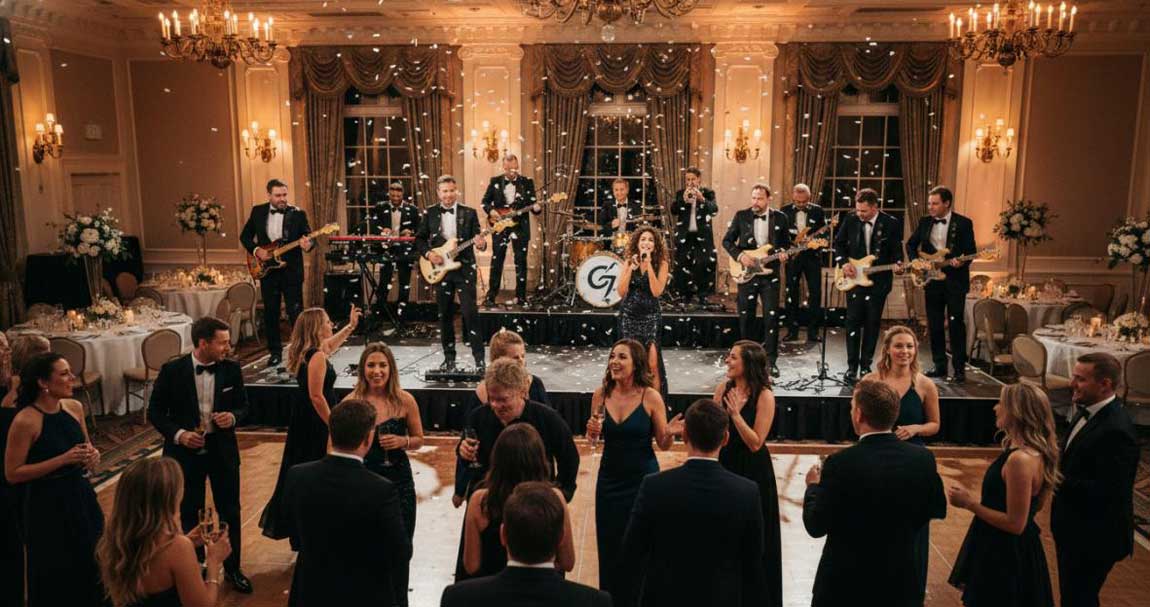
A high-energy live band performing on a brilliantly lit stage at an elegant corporate gala, with guests in formal attire dancing and celebrating in a large decorated ballroom with warm ambient lighting.
Galas often have a more structured flow: cocktail hour, dinner, awards or remarks, then open dancing. A professional corporate party band should be able to shift between those phases, moving from background jazz during dinner to high-energy dance sets once the floor opens.
Awards Ceremonies and Networking Events
Awards ceremonies require a different approach. The band is primarily there to support transitions, play walk-up music for award recipients, and energize the room between segments. A smaller configuration, four to six pieces, typically works better here than a full ensemble. The goal is presence without distraction.
Networking events present a similar challenge. Music should facilitate conversation, not compete with it. A jazz quartet or a string trio at moderate volume creates ambiance without forcing guests to shout across the table. According to research compiled by the International Live Events Association on event entertainment standards, sound level management is one of the most frequently cited complaints at corporate networking functions, making band configuration and volume discipline critical.
Cocktail Hours and Company Celebrations
Cocktail hours are where live music creates its strongest first impression. Guests arrive, drinks are flowing, and the band sets the tone for everything that follows. A four-piece jazz combo or acoustic duo works well in this setting, creating warmth without overwhelming the space.
Company celebrations, milestone events, and product launch parties tend to benefit from higher energy. These are moments where the company wants guests to feel the excitement, and a full corporate party band with a strong vocalist and tight rhythm section delivers that.
Band Sizes, Genres, and Customizable Repertoire
One of the most practical advantages of booking through a professional entertainment agency is the ability to customize band size and repertoire to match your event’s specific needs. There is no single “correct” configuration.
From Jazz Quartet to Full Show Band
Band size directly affects both cost and sound footprint. Here’s a practical breakdown:
- Jazz quartet (4 pieces): Piano, bass, drums, saxophone or trumpet. Ideal for cocktail hours, intimate dinners, and networking events. Low stage footprint, minimal AV requirements.
- Six-piece band: Adds lead vocals and one additional instrument (often guitar or a second horn). Versatile enough for dinner and dancing.
- Eight to ten-piece show band: Full rhythm section, multiple vocalists, horn section. Best for large galas, holiday parties, and events where a packed dance floor is the goal.
- String trio or quartet: Violin, viola, cello. Suited for upscale cocktail hours or ceremony-style moments within a corporate event.
The right size depends on venue capacity, room acoustics, and what you need the band to accomplish. A good entertainment agency will help you match configuration to context rather than upselling the largest option.
Top 40, Motown, Classic Rock, and Beyond
Repertoire is where corporate party bands separate themselves. A versatile setlist covering Top 40, Motown, classic rock, funk, and contemporary hits serves the widest possible audience. Most of the top professional corporate bands maintain a catalog of 100-plus songs and can build a custom set based on your guest demographics and event tone.
The most common mistake planners make is booking a band with a narrow genre focus for a mixed-age crowd. A band that only plays current Top 40 will lose the 50-plus contingent. A band that only plays classic rock will lose younger guests. The sweet spot is a band with genuine range, one that can open with Stevie Wonder, move into Bruno Mars, and close with a Journey singalong.
Tip
Ask any band you’re considering to share their corporate setlist. Real setlists reveal actual range far more honestly than a genre list on a website.
Band vs. DJ: A Decision Matrix for Corporate Planners
The band vs. DJ question comes up at nearly every corporate event planning meeting. The honest answer is that neither is universally better. The right choice depends on four variables: budget, venue, event format, and audience demographics.
| Factor | Live Band | DJ |
|---|---|---|
| Budget | Higher upfront cost | Lower cost |
| Audience energy | Builds organically | Consistent from start |
| Setlist flexibility | Custom but pre-planned | Near-unlimited on the fly |
| Visual impact | High (stage presence) | Moderate |
| Venue requirements | Stage, more power, more space | Smaller footprint |
| Best for | Galas, holiday parties, celebrations | Conferences, networking, mixed-format events |
| DJ collaboration | Can combine both | N/A |
A few situations where a DJ is genuinely the better call: events under three hours where setup time eats into the performance window, venues with strict sound ordinances that limit live amplification, and events where the playlist needs to shift across wildly different genres in real time.
A few situations where a live band is non-negotiable: when the event needs a visual centerpiece, when the client wants guests to feel the energy of a live performance, and when the company’s brand identity is tied to quality and experience.
Many corporate events now use a hybrid approach: a live band for the main corporate party entertainment set, with a DJ handling pre-show and post-show music. This gives you the best of both and is worth budgeting for when the event format allows it.
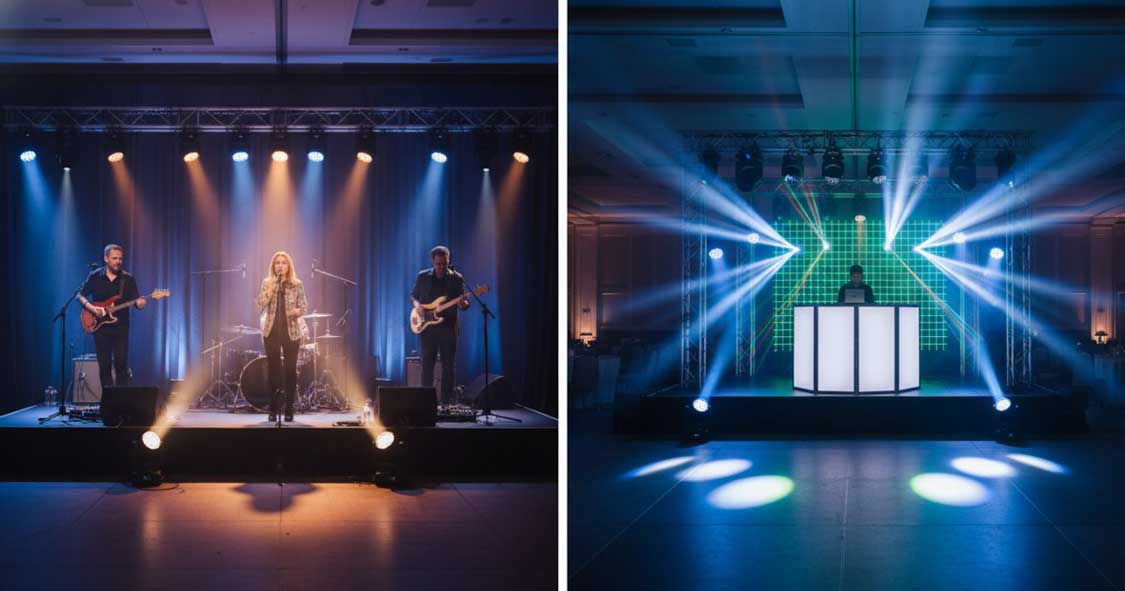
A professional live band setup on a corporate event stage with warm stage lighting, microphones, and instruments arranged and ready to perform in a modern conference venue with an empty dance floor in the foreground.
Corporate Party Band Cost Breakdown: What to Budget For
Corporate party band cost is the question every planner asks and almost nobody answers directly. Here’s a straightforward framework based on band configuration and market rates.
Many professional corporate bands price based on performance duration, travel distance, band size, and whether the booking includes production (sound and lighting) or assumes the venue handles AV. A general range for a professional corporate band runs from a few thousand dollars for a small quartet to significantly more for a full show band with production included. The specific number depends heavily on your market and the band’s experience level.
What matters more than the headline number is understanding what’s included.
Budgeting for Hidden Costs
The line items that catch planners off guard most often:
- Sound and lighting production: Many bands quote performance fees separately from AV. If your venue doesn’t have a house sound system adequate for a live band, you’ll need to rent one. This can add substantially to your total.
- Travel and accommodations: Bands outside your immediate area will charge for travel. For overnight events or multi-day conferences, hotel and per diem costs apply.
- Overtime fees: Most band contracts specify a performance window. Running long costs money. Budget for at least one overtime period as a buffer.
- Early load-in fees: If your venue requires the band to load in hours before the event starts (common in hotels with tight scheduling), some bands charge for that time.
- Gratuity: Not always expected, but standard practice for exceptional performances.
According to guidance from the Event Industry Council’s best practices for entertainment contracting, itemizing all production and logistics costs in the contract before signing protects both the planner and the performer.
Warning
Never finalize a band booking without a written contract that specifies exactly what is and is not included in the quoted fee. Verbal agreements on AV and overtime are the most common source of post-event disputes.
A realistic budget for a mid-size corporate event with a professional band should include the performance fee, production costs, travel if applicable, and a 10-15% buffer for logistics variables.
Corporate Event Production Requirements: AV, Stage, and Insurance
This is the section most entertainment guides skip, and it’s the one that causes the most problems on event day. Production requirements and insurance documentation are not optional details, they are the infrastructure your event runs on.
Technical Rider and Sound System Needs
Every professional corporate party band should provide a technical rider: a document specifying their sound system requirements, stage dimensions, power needs, and monitor configuration. If a band cannot produce a technical rider, that’s a red flag about their professionalism.
Key elements to review in a technical rider:
- Stage dimensions: Minimum stage size for the band configuration. A ten-piece show band needs significantly more space than a quartet.
- Power requirements: Live bands draw substantial electrical load. Confirm your venue can meet the band’s power specs before booking.
- PA system: Does the band bring their own, or do they require a house system? If they require a house system, confirm its specifications match the rider.
- Monitor mix: Musicians need on-stage monitors to hear themselves. This requires either a dedicated monitor mixer or an in-ear monitoring system.
- Backline: Some bands travel with all their own equipment; others require the venue or planner to provide backline (amps, drum kit, keyboards). Clarify this upfront.
Sharing the technical rider with your venue’s AV coordinator early, ideally at the time of booking, prevents the most common day-of production failures.
Insurance and Liability Documentation
Professional corporate party bands carry general liability insurance. This is non-negotiable for any reputable venue, and most corporate clients will require proof of coverage before the event.
Standard requirements typically include:
- General liability insurance: Coverage for bodily injury and property damage. Most venues require a minimum of $1 million per occurrence.
- Certificate of Insurance (COI): A document issued by the band’s insurer naming your company or venue as an additional insured for the event date.
- Workers’ compensation: Relevant if the band’s members are employees rather than independent contractors.
Request the COI at least two weeks before the event. Venues often require it as part of their permitting process, and last-minute requests create unnecessary stress. As noted in ASCAP’s guidelines for live performance licensing and event compliance, music licensing for live performances is also the venue’s responsibility in most cases, but confirming coverage protects everyone involved.
Questions to Ask a Band Before Booking Your Corporate Event
Asking the right questions before signing a contract separates a smooth event from a logistical nightmare. These are the questions to ask a band before booking that experienced planners use as their standard checklist.
- Can you provide a technical rider and proof of liability insurance?
- What is included in your quoted fee, and what is billed separately?
- How many sets do you perform, and how long are your breaks?
- Do you bring your own sound system, or do you require a house PA?
- How far in advance do you need to load in and soundcheck?
- What is your overtime policy and rate?
- Do you have backup musicians available if a band member is ill?
- What is your cancellation and rescheduling policy?
That last question matters more than most planners anticipate. Corporate events get rescheduled. Contracts that don’t address rescheduling clearly create expensive disputes. The National Association of Music Merchants’ resources on performance contracts offers useful context on standard industry contract terms worth understanding before you sign.
Tip
Always ask specifically about backup musicians. A world-class professional corporate band should have a clear protocol for last-minute substitutions, because illness and emergencies happen. A band without a backup plan is a risk you don’t need on a high-stakes event date.
Why Green Light Bands Delivers for Corporate Entertainment
Green Light Bands sits at the top of our recommendation list for corporate entertainment for a specific reason: genuine versatility backed by professional production values. Most entertainment agencies specialize in one lane. Green Light Bands operates across the full spectrum, from intimate jazz ensembles for cocktail hours to high-energy show bands built to keep a 500-person dance floor packed.
The roster covers bluegrass, classic rock, jazz, Top 40, country, and Motown groups, which means a single agency relationship can serve every event format on your calendar. That matters for corporate planners managing multiple events annually. You’re not re-vetting vendors for every occasion.
What distinguishes a Green Light Bands performance is the combination of high-energy execution and professional logistics. Their bands arrive prepared, with technical riders, insurance documentation, and the talent to wow the client’s specific audience. The goal, consistently, is an event that guests talk about for months, not just a competent performance that fills the time slot.
For corporate event entertainment specifically, that reliability is the differentiator. The music is excellent. The logistics work. Those two things together are rarer than they should be.
How the Booking Process Works
Booking a corporate party band through a professional agency follows a straightforward sequence, but the timeline matters. The most common mistake is starting too late.
Step 1: Define your event parameters. Before contacting any agency, know your date, venue, estimated guest count, event format (dinner, dancing, cocktail hour, or all three), and a realistic budget range.
Step 2: Request availability and initial proposals. Reach out to your agency with those parameters. A good agency will come back with band options matched to your event type and budget, not a generic roster dump.
Step 3: Review demo materials. Video is the most reliable way to evaluate a corporate party band. Video can show how the band handles an actual room.
Step 4: Request the technical rider and COI. Before any contract is signed, get these documents and share them with your venue coordinator.
Step 5: Finalize the contract. Confirm all line items: performance fee, production inclusions, travel, overtime rates, and load-in timing.
Step 6: Coordinate day-of logistics. Assign a point of contact on your team to work directly with the band’s road manager or booking contact on event day. Clear communication at this stage prevents the small issues that become big problems.
For most corporate events, booking should happen a minimum of three to four months in advance. Popular bands for holiday party season, typically October through December, book out even earlier. Waiting until six weeks out significantly limits your options.
Choosing the right live entertainment for a corporate event requires balancing creative vision with logistical discipline, and most planners find that getting both right simultaneously is harder than it looks. Green Light Bands handles both sides: a diverse roster spanning jazz, Top 40, classic rock, and beyond, paired with professional production values and the documentation corporate venues require. Contact Green Light Bands to discuss your event date and get matched with the right band for your audience, your venue, and your budget.
Frequently Asked Questions
How much do corporate party bands cost?
Corporate party band pricing varies widely based on band size, performance duration, travel, and market. A small jazz quartet or string trio may start around $2,500-$3,500, while a full show band with eight or more musicians can range from $10,000 to $20,000 or more. Hidden costs like sound equipment, staging, travel, and overtime fees can add 20-40% to your base quote. Always request an itemized proposal to understand your full corporate party band cost breakdown before signing a contract.
What questions should I ask a band before booking them for a corporate event?
Key questions to ask a band before booking include: Do you carry liability insurance and can you provide a certificate of insurance? What does your technical rider require in terms of stage size, power, and sound system? How many sets do you play and how long are breaks? Do you offer DJ services between sets? These questions protect your event logistics and ensure a smooth live performance.
Do corporate party bands provide their own sound equipment?
It depends on the band and the corporate event production requirements. Some bands travel with a full sound system and stage lighting, while others require the venue or client to supply a PA system, monitors, and backline gear. Always review the band’s technical rider carefully before signing a contract. For large venues or galas, a professional audio-visual company is often brought in separately. Clarifying this early prevents surprise costs and ensures the live music sounds its best on the night.
How far in advance should you book a corporate party band?
For most corporate events, booking three to six months in advance is strongly recommended. For peak seasons, particularly holiday parties in November and December, top corporate party bands can be booked out six to twelve months ahead. Booking early also gives you time to finalize event logistics, review the technical rider, and confirm insurance documentation.
What are the best genres for corporate party entertainment?
The most crowd-pleasing genres for corporate event entertainment include Top 40, Motown, classic rock, funk, and jazz. Top 40 and Motown keep dance floors packed across mixed age groups, while a jazz ensemble or string trio works beautifully for networking receptions and cocktail hours. Many professional bands offer customizable setlists, so you can request a high-energy dance set for the main event and a more relaxed background music set for dinner or awards portions of your corporate function.