

A Buyer’s Guide to Corporate Bands
When you hire a corporate band for your event, you want your guests to have a great time listening or dancing to their music, but you also want them to enjoy the band so much they’ll be talking about them long after the party is over, in addition to posting about them on social media.
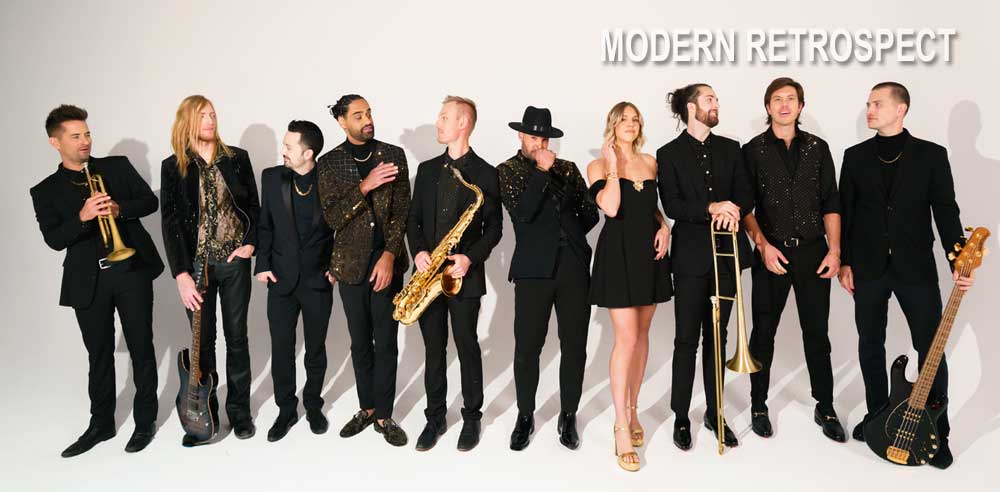
Modern Retrospect: Top-Rated Live Corporate Party Band
We at Green Light Bands have seen the same pattern repeat itself time and again while assisting thousands of corporate event planners: dependable corporate bands like Modern Retrospect and Party Echelon have attributes you’ll not find on a demo recording. In the article that follows we’re going to go over all the considerations, contract red flags included, so you can put your mind at ease when booking a corporate band.

Party Echelon: Premier Dance Band for Corporate Events and Gatherings
You’d be hard pressed to find a guide that doesn’t put all its stock in musical style to the exclusion of how a band actually operates. Consider a group with a good Top 40 sound; if they’re late to the venue, argue with the coordinator or don’t abide by the technical rider, it’s immaterial how well put together their setlist is, your event is ruined. The issue is not whether they can play, but whether they can perform and act in a professional manner given the circumstances that it’s an important corporate function.
The Core Qualities in a Corporate Band
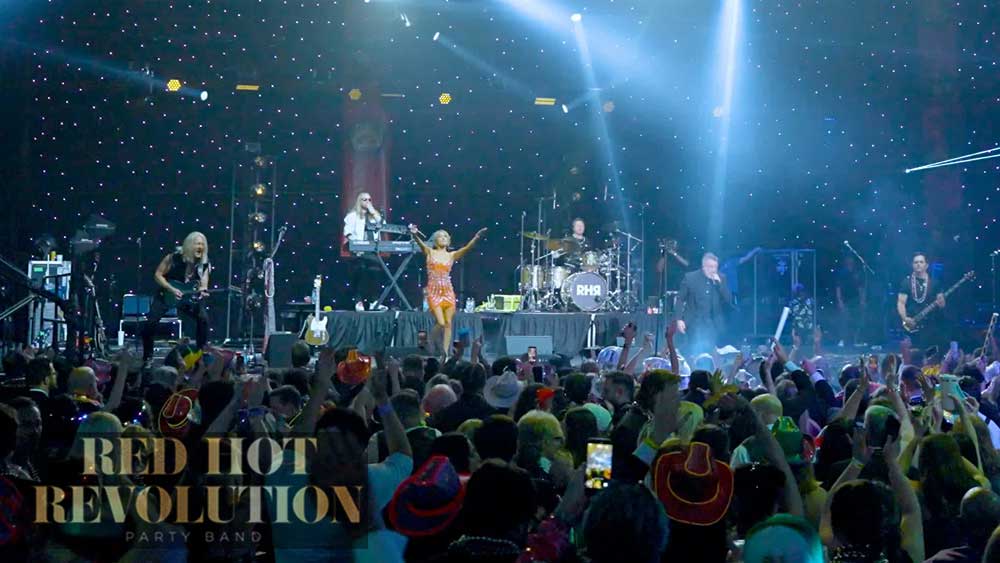
Red Hot Revolution: Live Corporate Performance
There’s a reason to engage the services of a world-class band such as Red Hot Revolution or Metro Music Club. These corporate event bands have been vetted for the rigors of a business environment where brand reputation and the make up of the audience are of consequence. The standards are simply higher than at a wedding or bar gig.
Professionalism and versatility are the hallmarks of a superior corporate band; everything else is secondary.

Metro Music Club Live Cover Band for Corporate Functions
Stage Etiquette and Professionalism
It’s easy to get excited by a good demo reel, but miss the stage etiquette, which should be your first point of evaluation. By professionalism we mean a band that’s punctual for load-in, puts on a proper appearance, is inclusive in their banter and leaves the off-color jokes and any griping about the sound system or other matters.

Music City Groove Band for Corporate Company Parties
Don’t be fooled into believing that a robust social media following is a substitution for on-site conduct. Ask them how they communicate in the run up to an event and if they have a history with corporate functions. You’ll see a marked difference in the way the formalities are handled by a band like Music City Groove or Glitterati with experience at product launches and holiday parties versus those whose resume is solely country music festivals.

Glitterati Party Band for Events
Versatility for the Room
You may have senior executives in their sixties in the room along with mid-twenties employees starting out in their careers. A setlist of nothing but current Top 40 will turn half of them off, as will an over-reliance on classic rock tunes.
The better live bands have no trouble moving from one era to the next. Few genres have the cross-over appeal of Yacht Rock or Motown. If a band can go from Stevie Wonder to Bruno Mars, they know how to keep an audience engaged. Have a look at a sample setlist for some range.
Choosing the Right Entertainment for Your Event
Your event format should be the determining factor in which band you book. There’s a big difference in doing this right or doing it wrong.
For a networking event you want the ambient tones of an acoustic act or jazz quartet to leave room for conversation. A product launch is the perfect occasion for a high-energy party band to mark the reveal and the festivities to come. Holiday parties require the most of a band: with the mood celebratory and guests at ease, the dance floor needs to remain active for a couple of hours.
Planners err in thinking the same format will do for every type of event. A seven-piece cover band is ideal for a holiday party but will be a nuisance at a client dinner. First match the band to the event, then make your adjustments. The International Live Events Association tells us that aligning the entertainment with the purpose of the event is paramount to attendee satisfaction once it’s over.
Venue Logistics and the Technical Rider
Events have a way of falling apart operationally when the technical rider is not given due attention by the event planner. This document is where a band lays out its needs in terms of stage size, power, load-in and the specifications for the sound system and monitors.
Before you put your signature on a contract, review the rider carefully. You want to know:
- Will the band supply their own sound system or is the venue’s sufficient?
- What’s required as far as the amount of time needed for a sound check?
- Does the venue’s stage measure up?
- Is there a curfew or other noise restrictions?
If the rider is anything less than detailed and professional, take it as a warning sign – ask for it during your initial talks, not after you’re bound by a contract.
Making a Commitment
Video demos are a fine substitute for seeing a band in person, provided the setting is comparable to yours.
Pay attention to a few things in the footage:
- The way they transition from one song to another
- If they ever put any energy into the slower parts.
- In what way does the lead vocalist engage an audience without overstepping?
- Does the stage setup, attire and overall visual presentation give the appearance of a professional environment?
When it comes to social proof, you’ll find that event planners’ opinions hold more sway than those of the general public. There’s no better indicator than a testimonial from a corporate event coordinator who has made repeat bookings with the band. Ask for some corporate client references you can get in touch with.
Planners tend to underestimate the importance of how a band presents itself. If they show up in matching clothes that fit the occasion, it shows they’re attuned to the professional context. Hiring a band that takes the stage wearing casual outfits for a black-tie gala will spoil the mood of the event.
Corporate Event Band Cost and Fee Structures: What to Know
The cost of a corporate event band is not the same for every band. Th price is dictated by the market, the size of the band, how long they’re scheduled to perform and if they bring their own production gear. Make sure you’ve got a handle on the fee structure so you won’t be caught off guard in negotiations.
Ask for an all-inclusive quote that includes everything from performance and travel to equipment and any overtime. Left unchecked, hidden charges for an extra set or extended load-in time will have your final invoice exceeding the figure you were given.
A professional corporate band will have general liability coverage, so be sure to ask them about it. If they’re unable to produce a certificate of insurance, consider it a red flag in any contract.
Live Band or DJ for Your Corporate Event?
There’s no single answer to which is superior, a band or DJ; it’s a question of what your event calls for.
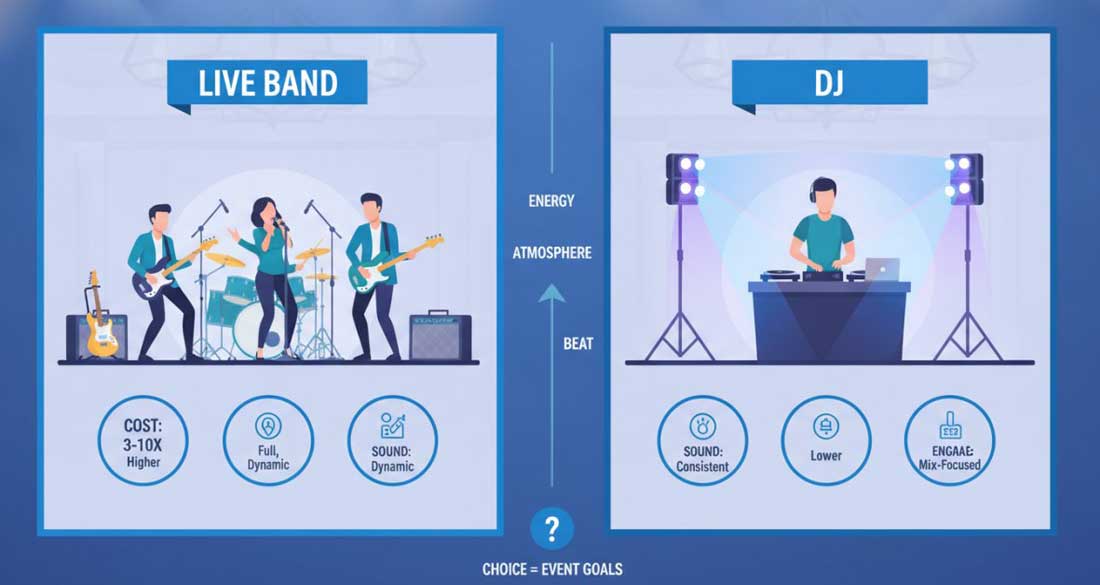
Split scene at a corporate event venue showing a live five-piece band with instruments and microphones on the left side of the stage and a DJ setup with turntables and LED lighting equipment on the right side, both under professional event lighting.
A live band is the way to go for a corporate gala, a product launch or holiday party where making an impression is the objective. The very act of watching musicians adds energy to the room and drives the dance floor in a manner that creates a shared experience. Live bands are well suited to entertaining and interacting with clients.
For a networking function where background music is what you’re after, or when the budget is tight, a DJ is a sensible choice. A good corporate DJ will have an extensive song list, and also be able to work in a venue with little stage space.
But make no mistake, when corporate event entertainment is the centerpiece, and not just ambient music, post-event feedback will show that a live performance is the winner over recorded music every time. It’s a primary factor in guest satisfaction at professional events.
A Pre-Hire Checklist: Questions for the Band
The difference between a smooth operation and discovering issues on the night of the event is knowing what to ask a band. Run through these questions in your first talks with the band or booking agency:
- How many events have been on your calendar in the last 12 months?
- Do you have references from corporate event planners you can share?
- What are the demands of your technical rider and is your sound system included?
- Should a band member be ill on the event date, what’s the contingency?
- Can you give me a certificate for your general liability insurance?
- What are your rates and policy for overtime?
- How much lead time do you need for sound check and load-in?
- Are you familiar with the technical side of our venue, or have you played here?
- What’s your dress code for a corporate function?
If a band gives you clear, unhesitating answers, they’ve done this before. Vague responses to simple logistics should tell you to move on.
Red Flags in the Contract
It’s in the negotiation of the contract that some event planners put themselves in a vulnerable position. Be on the lookout for the following in any agreement with a corporate band:
Payment terms that are not explicit: Typically you’ll make two payments, a 50% deposit to hold the date with the balance due a week or two before the event. Be wary of bands that want everything up front.
An absence of any provision for liability insurance: This is non-negotiable for a professional band; if it’s not in the contract, request a certificate prior to signature.
Scope creep: Without firm parameters on the number of sets, duration or time for setup and breakdown, you’re open to disputes.
No clause for substitution: How and by whom will an unavailable member be replaced? The contract should make this plain.
The American Bar Association’s guidance on event contracts would agree that disputes in event management most often center on scope-of-service definitions in entertainment contracts.
Making Your Final Decision
In the end, there are five criteria for assessing a corporate band:
- Professionalism track record: Go for verified references over a general history of performances.
- Versatility in repertoire: Can they cater to a varied audience across different eras and genres?
- Technical know-how: A clearly written rider and their own equipment are preferred.
- Peer social proof: Check what other planners are saying.
- Clarity in the contract: Deposit and balance payment terms and dates, insurance should be transparent.
A band that measures up on all five will ensure your event is as well presented as it is well heard. Green Light Bands has on its roster a range of live bands, Top 40 to Motown and jazz, all vetted and with the production values and corporate experience to suit any venue or event.
Use the checklist to help you locate the right band for your corporate event. If they can’t supply corporate references, a professional rider and answer your questions with confidence, then look elsewhere.
You can’t hide a poor choice of live entertainment at a corporate event; everyone in the room will notice. Green Light Bands offers performance bands with the kind of professional sound and production values that suit any venue, as well as the corporate pedigree to back it up. Our setlists are designed to appeal to all ages. Get in touch with us to put together the right act for your function.
Questions Clients Ask Us Frequently
What’s the cost of a corporate band?
There’s no set price for a corporate event band; you’ll see a wide variance in fees according to the size and experience of the band, how far they have to travel and for how long the engagement is. A small cover band can sometimes be hired for $6,500 to $7,500, but you’re looking at $10,000-$20,000 and up for a top tier party band with full production. Make sure to get an itemized quote covering everything from setup and sound to any overtime. That way there won’t be any budgetary shocks down the line and you can make a fair comparison of the different bands you’ve contacted.
When is the right time to book a corporate band?
We would counsel you to book your live band at a minimum of three to six months ahead for a corporate function. Reputable and experienced corporate cover bands don’t keep open slots for long, particularly in the run up to the fourth quarter holiday parties. An evening event on a Friday or Saturday, or one that’s during a major holiday, warrants an even earlier start to your search. It also affords you the time you need to work out the contract, go over the technical rider and make arrangements with the venue.
Will the band supply its own sound?
Some will, some won’t. Certain corporate bands come with a sound engineer, monitors and a complete sound system; others will look to the venue or planner for backline and audio. A good look at the technical rider prior to signing a contract is therefore a must. The rider has all the details on power, stage space and sound check, what the band requires and so on, which is the only way to ensure the day of the event goes off without a hitch.
Live band or DJ?
A live band is hard to beat for making an impression and raising the energy level of corporate client entertainment. There’s an audience response to a good cover band doing their Motown or Yacht Rock numbers that a DJ and his playlist can’t replicate. But it’s a more expensive proposition and demands more in the way of logistics. For the large corporate function where you want to make an impact, a world-class band is always the better investment. In a smaller venue or when the budget is tight, a DJ often makes more sense.