

How to Choose the Right Live Wedding Band: 2026 Guide
Choosing a live wedding band? Learn costs, contracts, questions to ask, and logistics tips to find the perfect band for your reception. Start planning.
Choosing the wrong live band is one of the most expensive mistakes a couple can make, and it happens more often than wedding planners will admit. How to choose the right live wedding band is a decision that shapes the entire emotional arc of your reception, from the first dance to the last song of the night. This guide from Green Light Bands breaks down every factor that matters, including the ones most couples overlook until it’s too late. Below, we’ll show you exactly how to evaluate bands, negotiate contracts, and avoid the logistical traps that derail otherwise perfect weddings.
Here’s what most guides get wrong: they treat this as a purely aesthetic decision. It isn’t. Choosing the right live wedding band is equal parts logistics, contract law, and musical taste. Get the logistics wrong and even the most talented musicians will underdeliver.
Wedding Band vs DJ: Pros and Cons You Need to Know First
The wedding band vs DJ debate is one of the first decisions couples face, and the answer depends on priorities more than budget. A live band creates an atmosphere that a DJ simply cannot replicate. The energy of real musicians feeding off a crowd, adjusting tempo in real time, and responding to the room is something no playlist can manufacture.
That said, DJs offer genuine advantages worth acknowledging honestly.
Live Band: Pros and Cons
| Factor | Live Band | DJ |
|---|---|---|
| Energy and atmosphere | High, dynamic, crowd-responsive | Consistent, controlled |
| Song selection | Limited by repertoire | Near-unlimited |
| Cost | Generally higher | Generally lower |
| Setup requirements | More space, more power | Minimal footprint |
| Sound consistency | Variable by performance | Highly consistent |
| Visual impact | Strong stage presence | Minimal Visual Impact |
A DJ can play the exact studio recording your guests know and love. A live band plays an interpretation. For couples whose guest list skews toward music purists or who have specific songs that simply must sound a certain way, that distinction matters. For couples who want a packed dance floor and a wedding atmosphere that feels like a concert, a live band wins every time, especially if a band like Rhinestone Rodeo is chosen.
The real question isn’t which is better in the abstract. It’s which serves your specific guest demographic, venue, and vision.
Warning
Many couples book a DJ as a “safer” choice without realizing that a skilled live band like Liquid Blue can drive higher guest engagement and longer time on the dance floor. The perception that bands are riskier usually comes from poor vetting, not from live music itself.
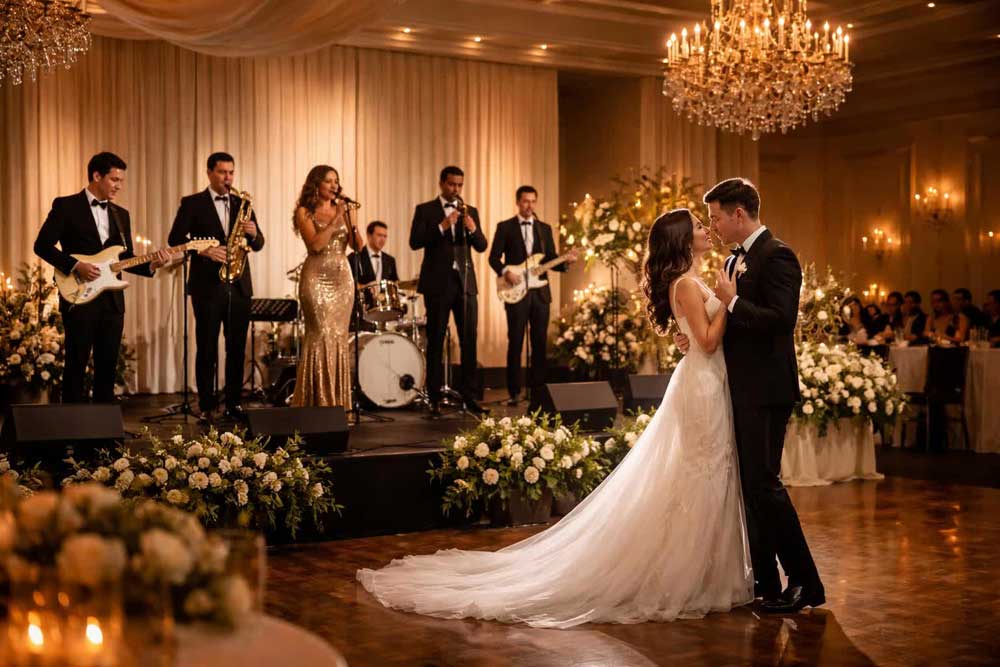
How to Choose the Right Live Wedding Band for Your Vibe and Venue
Matching your band to your wedding isn’t just about genre preference. It’s about understanding how musical style, room acoustics, and venue logistics interact.
Matching Musical Style to Your Wedding Atmosphere
A live wedding band performs best when the musical style aligns with the event’s emotional register. A jazz quartet creates an intimate, sophisticated cocktail hour but may not sustain a high-energy dance floor through midnight. A Top 40 cover band does the opposite. The mistake most couples make is choosing a band based on their personal listening habits rather than their guests’ demographics.
Think about your guest list in thirds. The youngest third wants current hits and high energy. The middle third wants recognizable classics from the 1980s through 2000s. The oldest third wants something melodic and accessible. The best live bands build setlists that cycle through all three, keeping everyone engaged across the night.
Green Light Bands maintains a diverse roster spanning Top 40, classic rock, country, jazz, and bluegrass, which means couples aren’t forced to choose between their taste and their guests’ enjoyment. A versatile setlist is a feature, not a compromise.
Tip
Ask any band you’re considering for their last five wedding setlists. If every setlist looks identical regardless of the couple’s stated preferences, that band isn’t customizing for your wedding. They’re running a template.
Venue Logistics and Audio-Visual Requirements
Venue logistics are where the decision gets technical fast. Before you fall in love with a band, confirm three things: the venue’s maximum sound level (measured in decibels), the available floor space for setup, and the power supply capacity.
Many historic venues, rooftop spaces, and outdoor locations have strict noise ordinances or limited electrical access. A seven-piece band with a full PA system may be physically impossible in a venue designed for string quartets. According to The Knot’s wedding planning resource center, venue compatibility is among the most cited reasons couples have to change their entertainment booking after the initial reservation.
Confirm the stage dimensions your venue can accommodate. Most full bands require at minimum a 16×20-foot performance area. Smaller ensembles can work in tighter spaces, but the bandleader needs to know the exact dimensions before the contract is signed.
Average Cost of a Live Wedding Band: Budgeting Breakdown
Live wedding band pricing varies significantly based on band size, geographic market, performance duration, and whether travel and accommodations are required. Rather than citing specific dollar figures that shift by region and year, here’s how to think about the cost structure.
The core pricing variables are:
- Number of musicians: More players means more fees, more equipment, and more setup time
- Performance duration: Most packages cover four to five hours of event time, including breaks
- Travel distance: Bands often charge per mile or a flat travel fee beyond a certain radius
- Day of week: Saturday evenings command premium rates in most markets
- Season: Peak wedding season (late spring through early fall) typically carries higher rates
Understanding Performance Packages and What They Include
A performance package is the bundled offering a band presents as their standard wedding service. Understanding what’s included versus what costs extra prevents budget surprises.
Most professional wedding band packages include:
- A set number of performance hours (typically 3-4 hours of music)
- Sound equipment and PA system
- Basic lighting rig
- A setlist consultation session before the event
- MC services for announcements and transitions
- One or two ceremony music sets (confirm this, as many bands price it separately)
What’s often NOT included in base packages:
- Cocktail hour music (may require a separate acoustic set or trio)
- Overtime fees if the event runs long
- Travel and accommodation for out-of-market bookings
- Special song learning fees for non-repertoire requests
- Ceremony sound setup (separate from reception PA)
Takeaway
The most common budget surprise in live wedding band bookings is the gap between the “reception package” price and the full-event cost once ceremony music, cocktail hour, and travel are added. Always ask for a line-item quote, not just a package price.
How to Vet a Live Band: Videos, Live Showcases, and References
The single most reliable way to vet a live wedding band is to see them perform live, ideally at a wedding or event similar to yours. Everything else, including videos, studio recordings, and sales calls, is secondary.

Many booking agencies and bands host showcase events specifically for prospective clients. These are worth attending. A showcase lets you assess sound quality, stage presence, crowd interaction, and the band’s ability to read the room. None of that translates through a promotional video. However, on the flip side, high profile wedding bands, like Red Hot Revolution and Modern Retrospect, are in demand due to repeat and referral business, and get all the jobs they want, so they have no incentive to offer a showcase.
Why Studio Recordings Can Be Misleading
Studio recordings are the least reliable indicator of live performance quality. A studio track is produced, mixed, and mastered under controlled conditions with multiple takes and digital correction. What you hear on a demo is not what you’ll hear at your wedding reception.
This is a point most band booking guides gloss over, but it matters enormously. A band that sounds polished on a studio recording may struggle with live sound check variables, outdoor acoustics, or the acoustic challenges of a venue with hard marble floors and high ceilings.
Ask specifically for unedited live performance footage, not highlight reels. A 10-minute unedited clip from a real wedding tells you more than a professionally produced three-minute promo video. Pay attention to the transitions between songs, how the bandleader handles the crowd, and whether the energy sustains across the clip.
Using Reviews and Vendor Recommendations
Vendor recommendations carry significant weight in the wedding industry. A wedding planner who has worked with dozens of bands across hundreds of events has pattern recognition that no online review can replicate. If your wedding planner recommends a specific band, that recommendation is based on observed performance under real event conditions.
Online reviews are useful for identifying red flags, including late arrivals, equipment failures, or poor communication, but they’re less reliable for assessing musical quality. According to WeddingWire’s vendor review guidelines, reviews that mention specific moments (first dance execution, crowd response, MC quality) are more informative than general praise.
Cross-reference at least three sources: online reviews, a vendor recommendation, and direct references from past clients. Ask references specifically about the band’s behavior during setup, their responsiveness to the event timeline, and how they handled any unexpected issues.
Questions to Ask a Wedding Band Before You Book
These questions to ask a wedding band separate professional outfits from amateur ones. Any band that hedges or can’t answer clearly is giving you useful information about how they’ll perform under pressure.
- Can we attend a live performance before booking? With less popular bands, yes.
- Who exactly will perform at our wedding? Some agencies substitute musicians without notice. Confirm the specific lineup is contractually locked in.
- What is your backup plan if a musician is ill or unavailable? Every professional band has a contingency protocol.
- How do you handle song requests on the night? Understand whether they take live requests and how they manage requests outside their repertoire.
- What is your typical setup time and what do you need from the venue? Setup typically takes 90 minutes to two hours, sometimes longer, for a full band.
- Do you provide your own sound engineer? This is a significant quality differentiator. A dedicated sound engineer means consistent audio quality throughout the event. The bands offered at Green Light Bands use sound engineers.
- What is your MC experience and style? The bandleader often doubles as MC. Ask for examples of how they handle announcements, introductions, and transitions.
- What happens if the event runs over the contracted time? Get the overtime rate in writing before signing anything.
- Do you carry liability insurance? This is non-negotiable. More on this below.
- Have you performed at our venue before? Familiarity with a venue’s acoustics and layout is a genuine advantage.
How to Choose the Right Live Wedding Band: Logistics Most Couples Overlook
Most couples spend 90% of their research time on musical style and 10% on logistics. The ratio should be closer to 60/40. The logistical details are where weddings go wrong.

Technical Rider and Power Requirements
A technical rider is a document that specifies the technical requirements a band needs to perform: power supply, stage dimensions, sound system specifications, lighting, and green room or holding area needs.
Every professional band should have one. If a band can’t produce a technical rider when asked, that’s a warning sign about their professionalism. Review the rider with your venue coordinator before signing the band contract. Conflicts between rider requirements and venue capabilities are far easier to resolve before booking than after.
Power supply is the most commonly overlooked technical requirement. A full band with a PA system, stage monitors, and lighting can draw substantial electrical load. Many older or boutique venues have limited circuit capacity. Confirm your venue’s available amperage with the venue manager and cross-reference it against the band’s power requirements in their rider. Running inadequate power to a band’s setup causes audio dropouts, equipment damage, and in worst cases, complete system failure mid-event.
Warning
Never assume a venue’s power supply is adequate for a full live band setup. Request the venue’s electrical specifications in writing and share them with your band’s production manager before finalizing the booking. Discovering a power conflict on the day of the wedding is a crisis that’s entirely avoidable.
Band Break Management and Event Timeline
Live musicians require breaks. A standard performance structure includes 45-75 minutes of live music followed by a 15-20 minute break. Over a four-hour reception, that means two to four breaks.
The question is what happens during those breaks. Professional bands handle this in one of two ways: a designated DJ playlist runs through the PA system during breaks, or a smaller acoustic subset of the band continues playing. Confirm which approach your band uses and ensure it aligns with your event timeline.
Work with your wedding planner to map the band’s break schedule against your event’s key moments. No couple wants the band on break during the cake cutting or the bouquet toss. Build the event timeline around the performance schedule, not the other way around.
Insurance, Liability, and International or Cultural Music Nuances
Liability insurance is a non-negotiable requirement for any professional live band. Many venues now require proof of insurance from all vendors before permitting setup. A band without general liability coverage creates risk exposure for both the venue and the couple.
Ask for a certificate of insurance before signing any contract. The certificate should list general liability coverage and ideally name your venue as an additional insured for the event date.
Cultural and international music nuances deserve more attention than most guides give them. If your wedding incorporates cultural traditions, confirm that your band has genuine experience performing that repertoire. A band that claims to play Bollywood, traditional Irish, klezmer, or Latin music without verified experience is a liability. Ask for specific examples, references from similar cultural events, and if possible, a sample of their performance of that repertoire.
According to The American Federation of Musicians’ guidance on live event contracts, professional musicians operating under union standards are required to carry appropriate coverage and adhere to specific performance and break schedules, which provides an additional layer of protection for clients.
Wedding Band Contract Checklist: What to Review Before Signing
A wedding band contract is a legally binding document that protects both parties. Review every line before signing. Here’s what must be present.
- Full legal name of the band or agency and the specific musicians contracted
- Event date, start time, end time, and load-in time
- Venue address and contact information
- Total fee, deposit amount, payment schedule, and accepted payment methods
- Overtime rate (per hour or per 30-minute increment)
- Cancellation and rescheduling policy for both parties
- Force majeure clause covering unforeseen circumstances
- Specific setlist requirements or special song agreements
- Substitution policy: who can replace contracted musicians and under what conditions
- Technical rider attached as an exhibit
- Proof of liability insurance attached or referenced
- MC services scope (what announcements are included)
- Meal and hospitality requirements for band members during the event
- Signature lines for both parties with dates
Read the cancellation policy from both directions. Understand what you owe if you cancel and what recourse you have if the band cancels. A reputable band will offer a clear refund or substitution policy in the event of their own cancellation.
Finding and booking the right live music for your wedding is genuinely complex, and the stakes are high. Green Light Bands offers a diverse roster of professional musicians spanning Top 40, classic rock, jazz, country, and beyond, with high-energy performances built specifically to keep dance floors packed from the first song to the last. Every band in their roster brings professional sound and production values, versatile setlists that serve all age groups, and the kind of live performance energy that turns a reception into an experience guests talk about for months. Contact Green Light Bands to start building the soundtrack for your wedding.
Frequently Asked Questions
How much does a live wedding band cost?
The average cost of a live wedding band varies widely depending on band size, experience, location, and performance length. Smaller ensembles or regional acts may start around $3,500-$7,000, while larger, high-demand bands can range from $12,000 to $20,000 or more. Most performance packages include setup time, sound check, and a set number of hours. Always clarify what is included before comparing quotes, and budget for overtime rates if your reception runs long.
What questions should I ask a wedding band before booking?
Important questions to ask a wedding live band include: How many sets do you perform and how long are breaks? Do you provide your own sound equipment? Are you insured with liability coverage? Can you handle MC services and announcements? What is your backup plan if a musician is unavailable? Do you have experience with our venue? Can you learn specific songs for the first dance or ceremony music? Getting clear answers to these questions helps you avoid surprises on your wedding day.
Should I hire a wedding band or a DJ?
Choosing between a live wedding band and a DJ depends on your budget, venue, and desired atmosphere. A live band delivers unmatched energy, live performance excitement, and a visual focal point that elevates guest engagement. A DJ typically costs less, offers a broader playlist, and requires less setup space. If keeping the dance floor packed with a high-energy, memorable experience is your priority, a live band is often worth the investment. For tighter budgets or smaller venues, a DJ may be the more practical choice.
How far in advance should I book a live wedding band?
Most professional wedding bands book up quickly, especially for peak wedding season dates. It is generally recommended to book your live band at least 9 to 12 months in advance, and even earlier if your wedding falls on a popular date or holiday weekend. Once you have confirmed your venue and reception date, securing your entertainment should be one of your next priorities. Booking through a reputable agency can help you find available acts faster and streamline the contract process.
Do wedding bands provide their own sound equipment?
Most professional wedding bands include their own sound system, speakers, and microphones as part of their performance package, but this varies by act. Always confirm what is covered in the technical rider before booking. Some venues have in-house audio-visual requirements or restrictions that may affect setup. Clarify power supply needs, load-in access, and sound check timing with both the band and your venue coordinator well in advance to avoid day-of conflicts.